
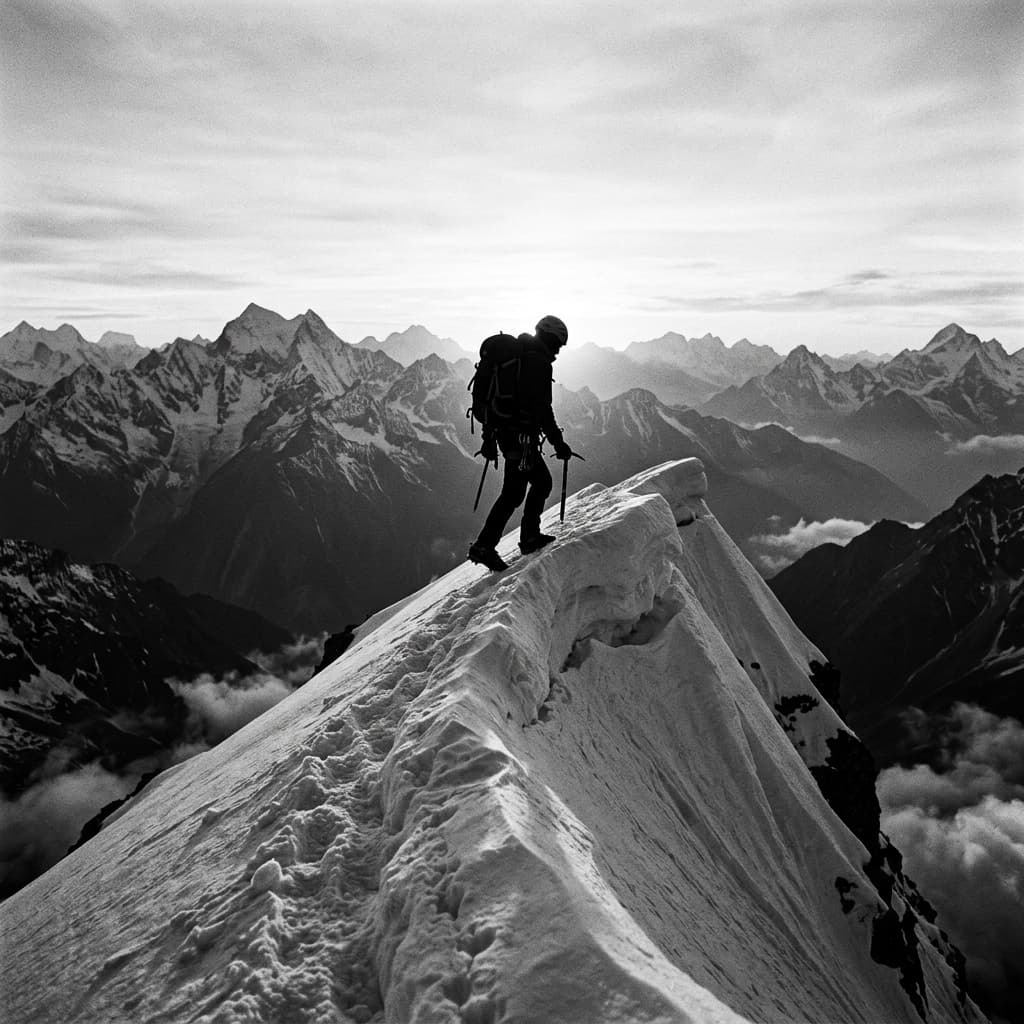
Digital sensors are incredibly efficient, but they lack weight. On our expeditions, we carry heavy mechanical steel cameras — mainly old Nikons and Leicas from the 1980s — loaded with high-contrast black and white film. There are no batteries to die in the sub-zero summits of Manali, no digital LCD screens to distract from the landscape, and only 36 exposures per roll.
You wait for the photograph to arrive — rather than chasing it with a burst of digital frames.
This constraint changes how we document. You do not fire bursts of 10 shots per second. Instead, you wait. You watch the sun crawl over a ridge line, highlighting the wind-blown snow patterns. You wait for a climber to stand still against a backdrop. The photograph is mapped in your head long before the shutter clicks.
The silence of the mountains and the silence of analog photography share the same frequency. In that space, you see differently. You stop looking for the perfect shot and start looking for the true moment.
Developing these rolls back at our basecamp is a slow ritual. When the silver crystals resolve on the negatives, the mountains appear not as tourist postcards, but as raw, contrasty structures of rock and ice. The B&W medium strips away the distraction of color, leaving only the pure architecture of the Himalayas.